Sapphire Labs
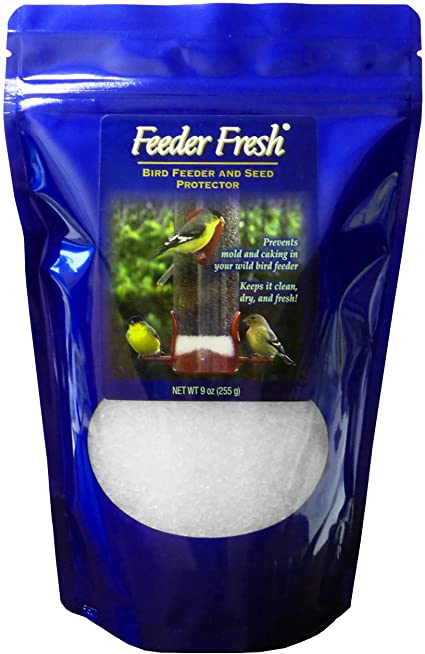
Feeder Fresh
Feeder Fresh
This product safely and effectively prevents the growth of disease-causing mold, ensuring a clean, dry, and healthy feeder for birds.
What is Feeder Fresh, and why should I use it?
Feeder Fresh is a moisture-absorbing product that preserves seeds in feeders. It's safe for birds and can be placed directly in feeders or in grain storage bins to reduce the negative effects of moisture such as clumping, mold formation, and seed spoilage.
Feeder Fresh promotes the health of wild birds by keeping feeders dry and reducing the chances of harmful mold and toxins developing. One of the most common sources of mycotoxins is poorly maintained feeders.
Is Feeder Fresh safe for birds?
Absolutely!
· Feeder Fresh is non-toxic. It's made from sand and is highly absorbent.
· The essential element of Feeder Fresh, amorphous silicon dioxide, is already consumed by birds in their natural habitat and is even necessary to ensure the strength of their eggshells. It is one of the safest materials in the world.
· Feeder Fresh was developed with bird safety in mind. The product manufacturers conducted extensive research to ensure that the product is not harmful to birds, and on the contrary, is good for their health. The product has been approved by Dr. Kirk Klasing, an avian physiologist at the University of California.
· Birds are able to recognize that Feeder Fresh granules are not seeds. When they come into contact with a granule, they simply discard it. If they were to eat one, the particle would act in the same way as sand in their gizzard. Feeder Fresh does not swell or clump.
· The product does not contain crystalline silica.
How does Feeder Fresh work?
Feeder Fresh has the internal structure of a microporous sponge, meaning the product contains billions of nanometer-sized pores that easily absorb water and moisture. These pores absorb water directly, or absorb excess water present in the air and seeds, creating a sealed, dry environment.
What types of feeders can I use Feeder Fresh with?
You can use Feeder Fresh in any feeder that has a closed structure. The more enclosed the feeder, the more effective the product. For example, silo feeders are ideal for using Feeder Fresh. Use the product at the bottom of the feeder.
How should this product be used?
Best performance is achieved when you place the product in your feeder where you usually observe moisture or mold problems. This is most often at the bottom of the feeder, especially if the grain tends to stagnate there. If placing the product at the bottom of the feeder is difficult, it can be mixed with the seeds at the bottom or layered throughout the feeder.
General usage instructions:
1. Start by cleaning and disinfecting your feeder.
2. Pour a layer of Feeder Fresh into the bottom of the feeder, between ¼ and ½ inch thick. The amount of product used depends on the extent of the moisture problem and the size of the feeder and its areas where seed flow is low.
3. For best results, you can also sprinkle a little of the product over the seeds each time you fill the feeder.
4. Replace the product as needed when you clean and maintain your feeder. The amount of product used over time will depend on weather conditions and the amount of moisture that enters the feeder (i.e., size of openings, presence of a dome over the feeder). If moisture problems persist, it means you are not using enough product, or not replacing it often enough, or the product is not placed in the right location.
You can also use Feeder Fresh in your grain storage containers to keep grains fresh longer and prevent them from absorbing moisture.
Made in the USA.
How often should I replace Feeder Fresh in my feeder?
Change the Feeder Fresh at the bottom of your feeder if:
· You notice that the Feeder Fresh takes on a darker or translucent appearance due to moisture absorption.
· The product has been in the feeder for more than a month.
· The product has been in the feeder for more than a week, and there has been heavy rain.
How can Feeder Fresh improve the health of wild birds?
You may already know this, but some of the most toxic compounds on Earth are created by molds. Even trace amounts of these mycotoxins can cause harmful or even fatal effects on birds. For example, 0.0001mg of aflatoxin, a byproduct of the mold type Aspergillus parasiticus that grows on grains, can be enough to be fatal for small birds. The more grains are exposed to moisture, the greater the risk of aflatoxin production. Feeder Fresh keeps grains and feeders dry, and prevents mold formation, which reduces the chance of aflatoxin and other mycotoxins being present.
Couldn't load pickup availability